About

Product design leader.
I build teams, shape craft, and connect design to business impact.

Background

Over 20 years working across agencies and product companies, I've had the chance to design for very different contexts [B2C, B2B, automotive, telecom, travel] before focusing on product design leadership in tech scale-ups.

My work now sits at the intersection of design craft, team growth, and business outcomes. I'm hands-on when it matters, and I know when to step back.

Joël Maurinier

Trajectory

Agencies

Phonevalley, DigitasLBi,
Backelite, Dagobert

Versatility by necessity. Switching domains (tourism, automotive, telecom, retail) built the ability to learn fast, frame problems without prior knowledge, and design for users I didn't know yet. Michelin, ORPI.

Product Design Lead

Renault Digital

Design at scale inside a large organisation. Led the transition of UX/UI profiles toward product design thinking. Introduced workflow tooling to align design with engineering. Built a skills framework that propagated across the Renault group.

Product Design Director

Contentsquare

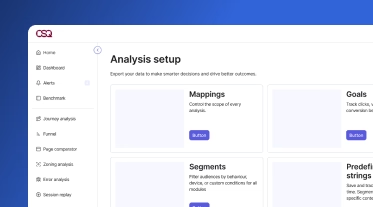
Scale-up pace, post-acquisition complexity, global teams. Recruited and onboarded 5 Senior Product Designers during a high-growth phase. Raised the bar on craft quality and business storytelling across the design team. Shipped Data Connect, a feature built through tight PM/Engineering collaboration and ahead-of-schedule research iteration.

🧠 How I work

I'm impact-driven and detail-oriented, both at once, not alternately. I communicate clearly and early, collaborate without friction, and stay proactive about surfacing new ways to frame a problem or approach a project.

I've learned that the quality of a team's work is inseparable from the quality of its conversations.

🛠️ Tooling

A tool is only a tool. Some are worth knowing well.

Figma remains central for ideation, component work, and increasingly for design-to-code workflows via MCP. GitHub is where the work lives and ships. Claude and Cursor are where a lot of the thinking and building happens right now, often together.

Working closer to the codebase is changing how we approach design problems.
It's still early, but it really feels like the right direction if we want design to have a stronger and a more lasting impact.

🔎 Beyond work

I read a lot across design, culture, and technology. I'm drawn to how ideas travel: how a concept moves from one field to another, how communication shapes understanding. Art, music, and digital culture are part of that same curiosity.

👁️ Points of view

Should designers code?

I have a real bias with this question for two reasons. First, I've coded for many years and I know how valuable it is to grasp front-end code when you design. Second, most of the senior designers I've managed as ICs were aware of the need to have a strong relationship with engineers in their squads, so they stayed close to coding.

Nowadays I would say yes. Roles are blurring and design has to embrace coding to have direct impact on the codebase and on the products. I do it myself, mainly with Claude Code, Cursor, and Figma MCP in read/write.

What happens to junior designers in a world where AI generates first drafts?

Junior designers' daily job is different now than what it was even a few months ago. I started with Information Architecture, research interviews and usability audits, and that foundation still matters. Junior designers have to go back to the basics of digital product design, even with the help of AI. Drafting interfaces is not where the value is anymore.

Today product design leaders have to make room for them to thrive in a landscape where the tools change faster than the roles, but they also have to resist the interface-first trap and focus on the why and the what. Those questions still require a human with judgment.

Why do design teams lose influence in scaling companies?

Scaling is a fast and demanding process. Design has been in its own bubble for too long, absent from strategy and prioritization decisions, and often acting as an execution bottleneck between product and engineering. Design keeps its influence when it earns it. By being present in the hard conversations, by connecting decisions to business outcomes, and by making product and engineering faster, not slower.

The teams that lose influence are the ones that waited to be invited. The ones that kept it went looking for the problem before anyone asked.

When should a company hire a Head of Design vs. a few strong ICs?

The strongest ICs can't do three things simultaneously: maintain a clear picture of the overall product, build and evolve the design system the team needs, and communicate as one voice with product and engineering leadership. Design needs a vision, a strategy, and a point of contact at leadership level. ICs can contribute to all of that, but owning it is not compatible with daily craft work, even with AI.

The trigger is usually one of three things: the product has more than two squads with designers, design decisions are being made without design in the room, or the design system is owned by no one. Any of those means the hire is overdue.