Role
Hands-on product design director.
I was responsible for the design vision and the crafting.
I worked on aligned outcomes and frequent feedback with a Product manager and a senior engineer to scope and to deliver.
Timeline
2018 - 5 day Sprint and additional work following
Results
- Stakeholders saw the B2B direction and bought in immediately.
Within weeks, MaaS became a dedicated initiative with its own team and budget. - Customers tested the prototype and found it intuitive, proof that the concept was strong enough.
- The sprint prototype seeded what became one of Renault Digital's core projects.
Context & Problem
Renault understood they could not depend on the traditional car ownership models in a market that was increasingly shifting toward shared mobility.
New competitors were already saturating the 'Mobility-as-a-Service' sector.
Renault needed to find new ways of winning in an increasingly competitive market.
Challenge
Renault's broader mobility vision was already taking shape as an ecosystem beyond vehicle ownership.
The challenge for us was moving fast enough to show concrete value before the window closed.
And to do that, we rapidly chose a real valuable and scalable solution.
Scope
I was tasked with combining elements of strategy and design.
I helped set the direction early, keeping the group focused on the desired outcome rather than letting discussions drift.
I managed the User Experience and User Interface Design when it was the time to transform 'talk' into 'touchable output.'
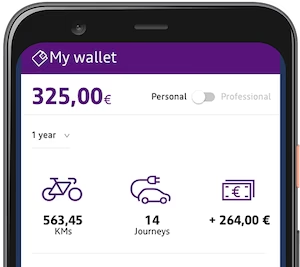
On the fourth day, I was able to deliver a prototype that was functional, and could be tested and demonstrated.
I didn't just design screens though. I directed the team towards a B2B fleet service when the group started focusing too much on consumer ideas. That change held the sprint in a concept that had actual commercial value.

Discovery
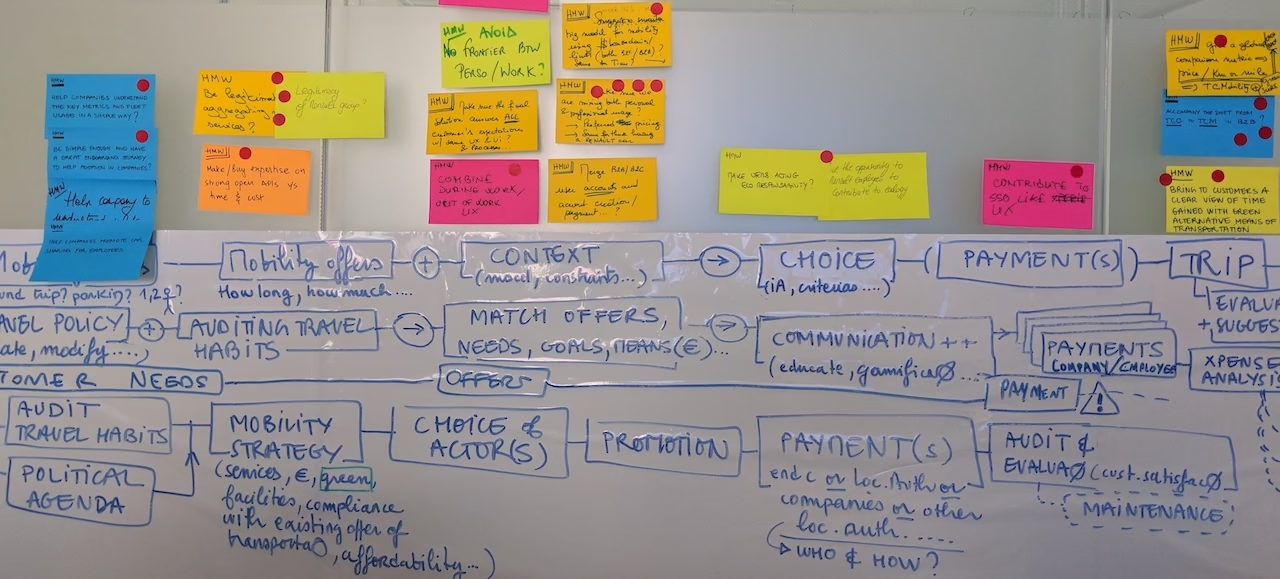
We mapped the mobility landscape, gathered expert perspectives, and tested assumptions against competing services.
Strategy
I defined core flows that captured the service's essence in mobile interactions.
Simplicity and clarity drove every choice, the goal was not completeness but proof of viability.
Execution
We built and refined the prototype in 48 hours.
Feedback came in overnight; we incorporated it by day 5.
On the final day, a testable, functional prototype was ready for stakeholder validation.
Key Decisions & Trade-offs
First, we shifted focus from B2C to B2B fleet services. This aligned with Renault's actual business (50% of sales are fleet).
We gained strategic clarity at the cost of broader market appeal.
Second, we built one refined prototype instead of many half-finished templates.
Third, we chose functionality over polish: a testable interface that proved the concept was worth more than a pretty one we couldn't validate in time.


Want to discuss this?
Other case studies

Michelin mobile
DigitasLBI
Provide a sustainable online mobile platform for current and future needs of Michelin US and other entities.

Design Jam
TTC Labs
Joint TTC Labs design jam workshop in Paris. Topic for the day: GDPR for startups.
Integration catalog
Contentsquare
Boost usage and retention with a merged and enhanced catalog of integrations.